Full Service Law Firm in Mt. Laurel Township, NJ | Capehart Scatchard

Articles

On July 20 2022, President Joe Biden called climate change an “existential threat” and unveiled new policies to fight its effects in response to Senator Joe Manchin’s objection to the Biden Administration’s proposed Federal wind legislation, which would create thousands of union jobs and offer more than $12 billion in annual capital incentives for wind projects located on both coastlines of the United States.

Senator Manchin represents West Virginia, which is a state dependent on the coal and natural gas industries. The Senator has personally made his wealth from the coal industry.  Senator Manchin has stated his objection to Biden’s proposed federal legislation is based on a deep concern about recent U.S. inflation. Manchin has suggested he might be open to considering a legislation package that includes climate and tax measures in September 2022, after further reports on U.S. Inflation.

“Climate change is an existential threat,” Biden said at a former coal-fired power plant in Massachusetts that’s being re-purposed to support wind power generation. “Since Congress is not acting as it should — and these guys here are but we’re not getting many Republican votes — this is an emergency, an emergency, and I will look at it that way,” the President said. However, President Biden held back on declaring a formal climate emergency.

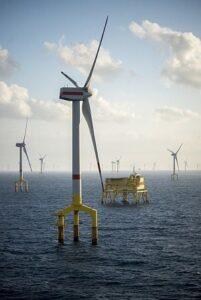
Biden’s climate change policies encourage offshore wind development in new areas along the US Coast and in the Gulf of Mexico. Biden is directing federal regulators to propose the first wind energy areas for development in the Gulf — a step toward auctioning leases to build the renewable projects.  Bloomberg Law reports, “Although Biden is directing Interior Secretary Deb Haaland to advance wind energy development in the southern Atlantic and along Florida’s Gulf Coast, he held off on reversing an order by former President Donald Trump that ruled out new offshore energy leases in those waters”, which could trigger unwelcomed opposition by Congress.

The Biden Administration climate change policy goals includes developing 30 gigawatts of offshore wind power by 2030, with auctions of territory near California expected later in 2022, and, ultimately, lease sales on almost every US coast.

The Bureau of Ocean Energy Management (BOEM) is moving forward with new offshore lease sales and plans to expedite review for operation plans. New ports and factories will need to be developed and constructed closer to the coast lines to service the wind industry.

For more information about New Jersey’s offshore wind programs, please contact Alan P. Fox, Esq.

In addition to investments in clean energy, the bill called the Inflation Reduction Act of 2022 (H.R. 5376) includes tax and health care provisions designed to reduce the federal budget deficit and limit inflation. However, much of the media’s attention has been on the climate provisions. The current compromised bill reduces investments from the original $2 billion “Build Back Better” Act proposed by the Biden administration.

The proposed bill is designed to accelerate the buildout of renewable energy and electric vehicles as well as boost the deployment of nuclear energy and increase domestic clean energy related to manufacturing and advanced energy technologies (such as storage, carbon capture, and green hydrogen).

Below is a summary of just a few of the tax incentives in the proposed legislation as currently drafted:

    • The proposed legislation both extends the existing Internal Revenue Code §45 PTC (production tax credit) and existing Internal Revenue Code §48 ITC (investment tax credit) for projects that commence construction by December 31, 2024, then transitions both §45 and §48 into new replacement tax code sections (one to be designated as “The Clean Electricity Production Credit” under new Internal Revenue Code §45Y and the other to be designated as “The Clean Electricity Investment Credit” under new Internal Revenue Code §48D).
    • Tax-exempt payers will have the option to elect direct pay for the clean electricity PTC and ITC as they would under the proposed amendments to §45 and §48.
    • The proposed bill would increase the ITC to 30% for solar, fuel cells, and small wind facilities in service after 2021.
    • The new proposed bill also creates a new “stand-alone” storage ITC for certain biogas, linear generators, thermal storage, microgrid, and dynamic glass technology.
    • Taxpayers electing the § 48D ITC will receive a credit worth up to 30% of the investment in the year the facility is placed in service. The tax credit value is increased by an additional 10% if the facilities also meet domestic-content requirements.
    • The credit value is further increased by 10% for projects in energy communities, including certain brownfield sites under CERCLA ( or example, where a coal mine has closed, or where a coal-fired electric generating unit has been retired.)

On August 11, 2022, with a tiebreaking vote from Vice President Harris, the 50-50 Senate passed the Inflation Reduction Act and sent the bill to the House of Representatives for a vote. The House is expected to approve this bill and send it to the White House for President Biden’s signature later this week. Solar industry advocacy group SEIA has already suggested that the tax credits under this Act could spur upwards of 30 GW of new solar panel manufacturing capacity in the United States and over 500,000 jobs.

For more information about the Inflation Reduction Act, please contact Alan P. Fox, Esq.

In addition to investments in clean energy, the bill called the Inflation Reduction Act of 2022 (H.R. 5376) includes tax and health care provisions designed to reduce the federal budget deficit and limit inflation. However, much of the media’s attention has been on the climate provisions. The current compromised bill reduces investments from the original $2 billion “Build Back Better” Act proposed by the Biden administration.

The proposed bill is designed to accelerate the buildout of renewable energy and electric vehicles as well as boost the deployment of nuclear energy and increase domestic clean energy related to manufacturing and advanced energy technologies (such as storage, carbon capture, and green hydrogen).

Below is a summary of just a few of the tax incentives in the proposed legislation as currently drafted:

    • The proposed legislation both extends the existing Internal Revenue Code §45 PTC (production tax credit) and existing Internal Revenue Code §48 ITC (investment tax credit) for projects that commence construction by December 31, 2024, then transitions both §45 and §48 into new replacement tax code sections (one to be designated as “The Clean Electricity Production Credit” under new Internal Revenue Code §45Y and the other to be designated as “The Clean Electricity Investment Credit” under new Internal Revenue Code §48D).
    • Tax-exempt payers will have the option to elect direct pay for the clean electricity PTC and ITC as they would under the proposed amendments to §45 and §48.
    • The proposed bill would increase the ITC to 30% for solar, fuel cells, and small wind facilities in service after 2021.
    • The new proposed bill also creates a new “stand-alone” storage ITC for certain biogas, linear generators, thermal storage, microgrid, and dynamic glass technology.
    • Taxpayers electing the § 48D ITC will receive a credit worth up to 30% of the investment in the year the facility is placed in service. The tax credit value is increased by an additional 10% if the facilities also meet domestic-content requirements.
    • The credit value is further increased by 10% for projects in energy communities, including certain brownfield sites under CERCLA ( or example, where a coal mine has closed, or where a coal-fired electric generating unit has been retired.)

For more information about the Inflation Reduction Act, please contact Alan P. Fox, Esq.

The New Jersey Board of Public Utilities (NJBPU) recently announced that New Jersey recently surpassed 4 gigawatts of solar-generated electricity produced by more than 157,000 solar installations statewide. This is enough “clean energy” to provide electricity to over 500,000 New Jersey households annually.  The NJBPU estimates that solar capacity in New Jersey could double in the next four years.  Clean energy generated by solar and wind power are key components to reach New Jersey’s goal to reduce carbon emissions in the state by 50% by 2030 and by 100% by 2050.

The NJBPU continues to move forward with a variety of solar programs, which include:

      • Community Solar Energy Program: After a two-year pilot program, NJBPU estimates during the third quarter of 2022, the NJBPU will issue the permanent program straw proposal. In the first year of the pilot program, the NJBPU approved 45 applications, with the capacity to generate about 78 MW in solar energy.  In the second year of the pilot program, the NJBPU approved 105 projects, with the capacity to generate about 165 MW in solar energy. These projects combined have the cumulative capacity to serve approximately 24,000 low to moderate income subscribers;


      • Competitive Solar Incentive (CSI) Program: The NJBPU continues to advance the development of its Competitive Solar Incentive (CSI) Program for grid supply and large net-metered solar. NJBPU has issued a straw proposal and has held three public comment sessions. NJBPU anticipates launching this program later in 2022;


      • Dual-Use Solar Pilot Program:  The NJBPU will be working to develop and implement a Dual-Use solar pilot program. NJBPU anticipates issuing a straw proposal later in the year;


      • Grid Modernization:  The NJBPU continues to move forward with its Grid Modernization proceeding to solicit ideas for potential improvements to enable faster interconnection and higher levels of distributed energy resource (DER) integration. In June 2022, a draft report was presented at a public meeting with recommendations for interconnection reform.


  • For more information about New Jersey’s solar programs, please contact Alan P. Fox, Esq.

When a plaintiff pleads in her Complaint that an accident aggravated a pre-existing injury, it is the plaintiff’s burden to provide a comparative analysis of the two injuries – the prior injury and the aggravation – in order to succeed on her claim that the accident caused the aggravation. The Appellate Division in Blocker v. DeLoatch, 2022 N.J. Super. Unpub. LEXIS 1059 (App. Div. June 14, 2022) held that when a plaintiff had a pre-existing injury but did not allege an accident caused an aggravation of that injury, it is the defendant’s burden to establish that the injury had multiple different causes.

In Blocker, the plaintiff’s medical history indicated she sustained a workers’ compensation injury to her lower back in 2015. Thereafter she was involved in two motor vehicle accidents about two years apart from one another: a three-car accident in Franklin Township in April 2016, and another motor vehicle accident in New Brunswick in March 2018. Plaintiff filed a complaint in April 2018, asserting a negligence claim against all of the other drivers in both of the 2016 and 2018 accidents seeking damages for “permanent injuries” sustained because of those two accidents. Plaintiff, however, did not allege that either the 2016 and 2018 accidents aggravated any previously sustained injuries. Plaintiff’s expert provided a report that indicated the plaintiff sustained a permanent injury caused by the 2016 accident, that was aggravated by the 2018 accident. She had no complaints prior to the 2016 accident.

Prior to the close of discovery, the defendants filed a motion for summary judgment arguing that, (1) the plaintiff’s failure to submit a comparative analysis of the injuries sustained prior to the 2016 accident; (2) the injuries suffered in the 2016 accident; (3) the injuries sustained in the 2018 accident; and (4) how those accidents may have aggravated or exacerbated the pre-existing lower back injuries, was fatal to her complaint. In response, the plaintiff provided her expert’s report from a doctor she claimed rebutted the defendants’ claims. The motion judge granted summary judgment, agreeing with defendants that the plaintiff’s expert’s report failed to provide any analysis as to whether or how the injuries from the 2016 accident were aggravated by the 2018 accident and that there was no review of anything concerning plaintiff’s pre-2016 injuries.

The Appellate Division reversed, holding that, in a non-aggravation case, a plaintiff need only show she sustained a permanent injury arising from the claimed accident to carry her burden without having to exclude all prior injuries to the same body part. The court determined that plaintiff only had to present proof of aggravation by way of a comparative analysis when she pled aggravation. Conversely, they held that a plaintiff is not required to present such an analysis when she does not plead aggravation. It follows that in such a circumstance the defense has the burden to show that the alleged injury existed at the time of the causal accident.

If it is fully incumbent on a defendant to bear the burden of establishing a plaintiff had a pre-existing injury to the same body part injured in a subsequent accident, a logical conclusion from the above appears to question the practice of alleging a plaintiff had an aggravation of a pre-existing injury at all. The strategy appears to be that, since it is the defendant’s burden to prove aggravation, a plaintiff’s attorney would anticipate that strategy, prepare a comparative analysis on the side and, in the event that a defendant does (a) discover a pre-existing injury and (b) provide the proofs to establish same, produce the comparative analysis to rebut the claims made by a defendant. On the other hand, to carry their own burden, the defendant should investigate a plaintiff’s medical history to uncover prior injuries, have their expert establish the aggravation and prepare for the showdown with the plaintiff.

In Moravia Motorcycle, Inc. v. Allstate Ins. Co., 2022 U.S. Dist. LEXIS 83043 (W.D. Pa. May 9, 2022), the United States District Court of the Western District of Pennsylvania dismissed an insured’s negligence claim against its insurer carrier but upheld a bad faith claim for the insurer’s sudden and unexplained denial of benefits for property damage to a motor home after previously accepting the claim causing the insurer further damage.

In April 2020, plaintiffs’ motor home was damaged after a storm caused a tree branch to fall on the motor home’s roof. The damaged roof allowed water to seep into the home. Plaintiffs notified their insurer, who sent an adjuster to evaluate the damage. The adjuster concluded that the damage was covered under plaintiffs’ policy. Allstate, the insurer, then sent a second adjuster without explanation to again inspect the damage. The second adjuster denied the claim. The motor home was not repaired resulting in additional damage including electrical issues, decay of the interior walls and mold growth. As a result of this denial, plaintiffs filed negligence and bad faith claims against Allstate.

Allstate moved pursuant to Rule 12(b)(6) to dismiss plaintiff’s negligence and bad faith claims for failing to state a claim for which relief can be granted. Plaintiffs’ negligence count argued that Allstate misrepresented the status of the policy, failed to fully advise them of the actual terms of coverage, failed to train its agents about the coverage, failed to inform its agents as to the proper manner by which policyholders should be advised about the scope and extent of insurance coverage and failed to inspect the motor home in a workmanlike manner.

Plaintiffs’ bad faith count was based upon Allstate’s alleged conduct in violation of 42 Pa. C.S. § 8371, which is Pennsylvania’s bad faith statute. To prevail on a bad faith claim under 42 Pa. C.S. § 8371, a plaintiff must demonstrate (1) that the insurer did not have a reasonable basis for denying benefits under the policy and (2) that the insurer knew or recklessly disregarded its lack of a reasonable basis in denying the claim. Nealy v. State Farm Mut. Auto. Ins. Co., 695 A.2d 790, 792 (Pa. Super. 1997).

The District Court granted Allstate’s motion as to the negligence claim but denied the motion as the bad faith claim. Allstate argued that the only relationship between the parties was the insurance contract and, therefore, the parties can only be held to their contractual obligations and not a broader tort standard. Plaintiffs relied on Bruno v. Erie Ins. Co., 106 A.3d 48 (Pa. 2014) in which the Pennsylvania Supreme Court allowed a negligence claim to proceed against an insurance company when its adjuster and engineer found mold in the plaintiff’s basement but advised it was harmless. The plaintiff’s house ultimately became uninhabitable and the court allowed a negligence claim to proceed based on the assurances made by the insurer’s representative that were outside the scope of the contract.

The District Court distinguished Bruno from the present case as Allstate’s adjuster in the present matter did not make any representations regarding the damage. The adjuster merely denied the claim based on the terms of the policy. Plaintiffs did not allege that Allstate took any actions or made any representations outside of the contract to warrant a negligence claim.

The District Court denied Allstate’s bad faith claim despite Allstate’s arguments that plaintiffs failed to plead with specificity, name any of the adjusters personally or plead how the coverage decision was conveyed. The District Court held that plaintiffs sufficiently pled a legally cognizable claim for bad faith under 42 Pa. C.S. § 8371 since plaintiffs alleged that the first adjuster approved the claim but a second adjuster inexplicably denied the claim without explanation causing plaintiffs further damage.

While plaintiffs were ultimately not successful in pursuing a negligence action against Allstate, the District Court did state under which circumstances a negligence claim between parties of contract can proceed. Actions and words by an insurance company’s representatives can open up the insurance company to a negligence claim thereby exposing the company to different and greater damages than those contemplated by the insurance contract.

By: Erika Vasant, Law Clerk
Editor: Patrick J. Graham, Esq.

In Schutt v. Dynasty Transp. of Ohio, Inc., 203 A.D.3d 858 (2022), the Supreme Court of New York, Appellate Division, Second Department reaffirmed the State’s current understanding of Labor Law §240(1). In this case, plaintiff, an elevator assembly employee, was unloading the components of an elevator from a truck. As plaintiff was attempting to move a hydraulic jack, his foot slipped and he fell down two feet from the truck bed injuring his shoulders and back. When plaintiff stood up, he noticed that an oily substance was on his clothes, which he determined to have originated from the truck’s bed.

Plaintiff filed a complaint alleging violations of Labor Law §240(1) and §241(6) as well as negligence by the defendants. The Supreme Court, however, granted all the defendants’ motions to dismiss, and the plaintiff appealed.

The Appellate Division first referenced the notes in Labor Law Section 240(1) which states:

Labor §240(1) should apply only to circumstances where there are risks related to elevation differentials since types of devices which statute prescribes (ladders, scaffolds, etc.) share common characteristic related to relative elevation at which task must be performed or at which materials or loads must be positioned or secured.

As such, the Court reasoned that if plaintiff’s injury resulted from an elevation risk, but the fall was actually caused by spilled oil, the fall would constitute a separate hazard. Leaning on the Court of Appeals of New York’s decision in Nicometi v. Vineyards of Fredonia, LLC, 25 N.Y.3d 90 (N.Y. 2015), the Court noted that “regardless of the type of safety device involved, liability arises under Labor Law §240(1) only where the plaintiff’s injuries are the ‘direct consequence’ of an elevation-related risk not a separate and ordinary tripping or slipping hazard.”

Prior to Nicometi, the Court of Appeals held that “…the question is whether the circumstances surrounding plaintiff’s work subjected him to the sort of risk which Section 240(1) was intended to obviate.” Rocovich v. Consolidated Edison Co., 78 N.Y.2d 509, 514 (N.Y. 1991). In analyzing both Nicometi and Rocovich the Court affirmed that Labor Law §240(1) only applied to injuries caused by elevated surface differentials.

Nonetheless, the Court did not dismiss the claims against the same defendants regarding the causes of action relating to Labor Law Section 241(6) based on 12 NYCRR 23-1.7(d). The law bars employers from allowing employees to “use a floor, passageway, walkway, scaffold, platform, or other elevated working surface which is in a slippery condition.” N.Y. Comp. Codes R. & Regs. tit. 12 §23-1.7 (2021). In this case, the Court found that the defendants did incur liability by allowing Plaintiff to perform his work in the truck amidst spilled oil.

Fundamentally, this case continued Labor Law §240(1) preference for employers because liability is only incurred when the injury stems from a device that creates elevation risks. If an injury stems from any other type of object that has no elevation risk, then employers are exempt from liability. Even so, employers must remain careful so as to not permit employees to perform their work in slippery conditions in order to avoid violating 12 NYCRR 23-1.7(d).

_________________________________________________________

Erika Vasant is one of Capehart Scatchard’s 2022 Law Clerks. Ms. Vasant is a rising 3L at Rutgers Law School. She has played an active role in diversity as President of the South Asian Law Students Association. Currently, she is President of the Rutgers Employment and Labor Law Association, Vice President of the Animal Legal Defense Fund, and the Notes and Comments Editor for the Women’s Rights Law Reporter. Last summer, she interned with the Honorable Judge Younge in the United States District Judge for the Eastern District of Pennsylvania. She is incredibly honored to be interning at Capehart Scatchard this summer!

On June 8, 2022, the New Jersey Board of Public Utilities issued an Order conditionally granting a petition which requested an extension to the project’s solar Transition Incentive (“TI”) Program registration deadline. As part of this Order, the Board has defined a set of criteria to identify similarly situated projects which may be eligible for a comparable extension.

If you have a TI project that is approaching a registration deadline, please contact Alan P. Fox, Esq., Chair of the firm’s Alternative Energy Group, to explore whether your project is eligible for a comparable extension.

On June 6, 2022, the White House released a statement authorizing the use of the Defense Production Act (DPA) to build up domestic production of solar panels, electric transformers, heat pumps, insulation and hydrogen-related equipment.

The U.S. Department of Energy (DOE) could support those sectors through commitments to buy clean energy products from U.S. manufacturers; direct investments in facilities; and aid for clean energy installations in homes, military sites and businesses. Pending legislation (the Energy Security and Independence Act) would provide $100 billion in DPA funding for the clean energy sector.

The White House reports the expansion to domestic solar manufacturing capacity will grow the current capacity of 7.5 gigawatts by an additional 15 gigawatts, enabling 3.3 million homes to switch to clean solar energy. President Biden also urges Congress to pass tax cuts and additional investments that advance U.S. clean energy manufacturing and deployment.

Specifically, the White House is authorizing the DOE to rapidly expand U.S. manufacturing of the following five clean energy technologies:

    1. Solar panel parts including photovoltaic modules and module components;
    2. Building insulation;
    3. Heat pumps;
    4. Equipment for making and using clean energy-generated fuels, including electrolyzers, fuel cells, and related platinum group metals; and
    5. Power grid infrastructures such as transformers.

In August 2021, the New Jersey Board of Public Utilities (“NJBPU”) launched the Administratively Determined Incentive (“ADI”) Program megawatt (“MW”). The program provides incentives to eligible solar facilities that are net metered residential, net metered non-residential 5 megawatts and eligible community solar on an interim basis. New registrations for each MW block are accepted on a first-come, first-served basis until either (1) the MW block is fully subscribed or (2) the capacity allocation expires at the end of the Energy Year, whichever occurs first.

The NJBPU recently set ADI Program block allocations for Energy Year 2023 (“EY2023”), which runs from June 1, 2022 through May 31, 2023. These MW block allocations are now in effect.

The EY2023 MW block allocations are as follows:

      • Net metered residential projects: 150 MW
      • Net metered non-residential projects (5MW and below): 150 MW +  any unused EY2022 capacity
      • Community solar: 150 MW
      • Interim subsection (t): 75 MW, or approximately 3 months from the Competitive Solar Incentive (“CSI”) Program’s first solicitation, whichever occurs first.

The ADI Program will therefore carry forward without interruption. The Board has made no change to the ADI Program incentive values at this time.

Capehart Blogs

Subscribe to Blog Updates

Categories