Claims

Plaintiff Dawn Dunkerly made a claim against her homeowner’s insurance company, Encompass Insurance Company, for the fire loss of her parents’ home. A fire swept through the house and completely destroyed it. As executor of her parents’ estate, plaintiff submitted a claim to defendant Encompass under her parents’ homeowners policy to be compensated for the loss.  In Dunkerly v. Encompass Ins. Co., 2017 U.S. Dist. LEXIS 179452 (D.N.J. Oct. 27, 2017), the issue was whether plaintiff was entitled to be compensated based upon the home’s higher replacement value or whether she was limited to the lower actual cash value of the home because she failed to rebuild the home.

Encompass paid plaintiff $341,521 for the actual cash value of the house, less a $500 deductible. Plaintiff contended, however, that she was entitled to an additional $108,006, representing the difference between the actual cash value of the house that was destroyed and the replacement value of the house. She sued Encompass to recover the additional monies she claims were due.

The dispute centered on 2 provisions in the insurance policy concerning the payment due. The first provision, Section (3), stated that the insurance company “will pay no more than the actual cash value of the damage until actual repair or replacement is complete.” However, it must be read in conjunction with Section (5), which stated that: “You may disregard the replacement cost less settlement provisions and make claim under this policy for loss or damage on an actual cash value basis. You may then make claim within one year after loss for any additional liability on a replacement cost basis.”

Encompass filed for a summary judgment to dismiss plaintiff’s claim, arguing that the plaintiff’s claim must be dismissed because she had not rebuilt the home. Hence, under its policy provisions, she was limited to the lower actual cash value of the home.

Plaintiff argued that there was a dispute of fact as to the interpretation of these clauses. Further, she argued that since insurance policies should be viewed most favorably to the insured party, the policy should be interpreted to award her the difference between the actual cash value and the replacement value of the house.

The District Court rejected the plaintiff’s arguments. It found that a difference in opinion over an insurance policy’s terms does not necessarily equate to a material dispute of fact. The interpretation of insurance policy language is generally a question of law because it is a contract. Ordinary principles of contract law would apply. Here, there was no dispute of fact. The parties simply disputed the legal consequences of the words of the policy.

The Court found that “a plain reading of the insurance policy supports Encompass’s position and cannot be read to support Dunkerly’s position.” It held that the relevant insurance policy provisions were clear and unambiguous and, based upon New Jersey law, should be enforced as written.

The Court found that the policy provisions clearly limited the homeowner’s recovery to the actual cash value of the house until “actual repair or replacement” is complete. Moreover, the policy also imposed a clear time limit on claims for replacement value in that a claim must be made within one year after the loss.

Nevertheless, the plaintiff claimed that she should be entitled to the additional monies under the replacement cost provision, arguing that she should still be entitled to the extra monies even if she did not rebuild.  The District Court rejected this argument because it was contrary to the plain language of the insurance policy provisions. It found that the policy language was not complex, not ambiguous, and did not contradict the understanding of the average purchaser. Hence, the Court granted the motion for summary judgment of the defendant insurance company and dismissed the plaintiff’s complaint.

By: Michael Weiner, Workers’ Compensation Claims Examiner
Editor: John H. Geaney, Esq.

As adjusters we are constantly being reminded to document our files: specifically, keep good log notes. We have all heard managers and supervisors repeat this mantra: “If it is not in the notes, it did not happen!” Good claim notes should “tell the story of the claim.” But what is the best way to keep good claim notes? Is there only one way to accomplish this task? Probably not.

Over 28 years, I have developed my own system of keeping detailed and accurate claim notes. Essentially, I label every note that I take. Now I know some computers systems have note headings, but I label it anyway because when the notes are printed they always show who I am talking to. Sometimes the headings do not show up on the printed copy.

Here is how my personal system works: I categorize my note into five broad categories. They are Claimant, Doctor, Client, Defense Contact and Action Plan. These categories correspond to the individuals I am talking to most often in the life of the claim. Once the category is indicated, I then provide detail on the entry. At the end of every note that is being entered as part of a diary I include the caption of Action Plan. I do this for two reasons. The first is management finds this very useful. The second is that it helps me focus steadfastly on closing the file.

In the Action Plan I discuss my thoughts and expectations as to how I will resolve the claim. I find that having an action plan in the notes helps me the next time I look at the file. I know what I need to do and why I wanted to do it the next time I look at the file.

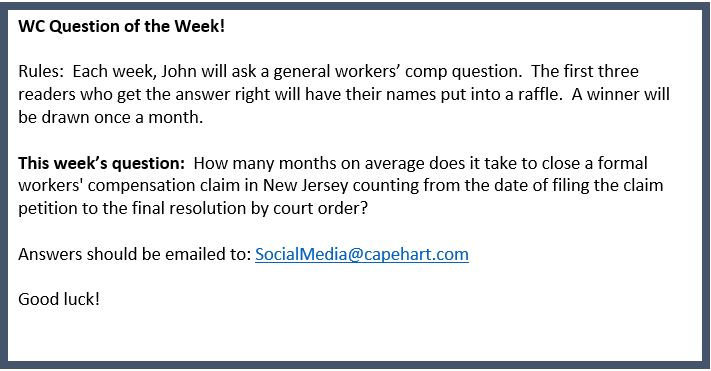
New Jersey comp files can sometimes stay open for years. The average file is in the Division is open for two years and three months. My goal is to close cases as quickly as I can within the appropriate level of exposure, and clear and useful log notes help me achieve that goal.

From time to time, Mr. Geaney invites Guest Bloggers on workers’ compensation matters.  Mike Weiner, an experienced adjuster, was kind enough to submit this blog today.  Please send any feedback to Mike at vmamweiner@gmail.com.

New Jersey law has very strict procedures for workers’ compensation carriers to follow in subrogation, and failure to comply with those strict rules can mean loss of subrogation rights, as noted in Pino v. Polanco and New Jersey Manufacturers, A-5027-15T4 (App. Div. November 22, 2017).

Ms. Pino was injured in a work-related car accident on May 20, 2011.  Another vehicle driven by an uninsured driver, Polanco, struck Pino’s vehicle.   Pino had uninsured motorist coverage with NJM.  Hartford paid workers’ compensation benefits totaling $48,056.79 for medical and temporary disability benefits.  The Hartford subrogation representative sent a letter to Pino’s attorney dated December 5, 2011 advising counsel of its subrogation rights under N.J.S.A. 34:15-40.  The letter asked that Pino notify Hartford if she was not going to proceed with a third-party claim.

In April 2013, Pino filed a personal injury action against Polanco and later amended the complaint to name NJM as a direct defendant under the uninsured motorist policy.  The parties eventually decided to arbitrate their dispute and entered into a “Stipulation of Dismissal Without Prejudice Subject to Reinstatement” of the law suit.   The arbitrators awarded Pino $65,000 subject to the workers’ compensation medical lien.  NJM rejected the arbitration and sought a jury trial, believing that Pino could not get past the verbal threshold and would likely lose.

Ultimately Pino chose not to reinstate the Law Division case, which meant no recovery at all.  But The Hartford did not know this.  There was a long gap in time between the arbitration in July 2015 and the point in time when The Hartford finally learned about the ultimate outcome of the UM matter on January 26, 2016.  Once The Hartford found out, it quickly filed a motion days to set aside the dismissal without prejudice and reinstate its complaint against NJM.  That motion was filed well past 90 days from the dismissal without prejudice in 2014 but within 90 days from when The Hartford found out about the dismissal and decision not to pursue the matter.  The trial judge rejected The Hartford’s motion based on an obscure provision contained in N.J.S.A. 34:15-40(f).  That provision states:

Where an injured employee or his dependents have instituted proceedings for recovery of damages for his injuries and loss against a third person and such proceedings are dismissed for lack of prosecution, the employer or insurance carrier shall, upon application made within 90 days thereafter, be entitled to have such dismissal set aside, and to continue the prosecution of such proceedings in the name of the injured employee or dependents in accordance with the provisions of this section.

The Hartford appealed and argued that the 90 days should start from when the company learned that the UM matter had been dismissed.  NJM argued that the statute says 90 days from the dismissal for lack of prosecution.  The Appellate Division contemplated that one reason for the 90-day rule is undoubtedly to foster expeditious resolution of subrogation claims.  There are no reported decisions on this particular issue, as noted by the Court.

The Appellate Division was not sure that a dismissal for “lack of prosecution” mentioned in the statute fit precisely the “dismissal without prejudice” in this matter, but it said that the statute says what it says, and it does not have a provision for a “knowledge requirement.”  The Court explained, “We share the trial court’s observation in its oral ruling that perhaps Pino or her attorney should have advised The Hartford of the June 2014 dismissal of the UM case sooner, consistent with the request that The Hartford had made in December 2011 to be kept advised of the matter’s status.  However, we are aware of no authority that imposes a legal duty upon an employee or her personal injury attorney to supply such notice.”

The Court went on to state that the record did not disclose proof that The Hartford regularly followed up with Pino or her counsel about the status of the third party recovery following the December 5, 2011 letter.  The Court seemed to be laying some blame on The Hartford for not being more diligent.  While this case involves a very rare problem in the law, it is interesting to read in that the Court favored a very technical study of the obligations under N.J.S.A. 34:15-40.   It is precisely for situations like this that subrogation representatives must vigorously follow up on the status of third party law suits and arbitrations.  There is never too much diligence in keeping tabs on third party law suits.

Thanks to Ron Siegel, Esq. for bringing another important case to our attention.

Can an employee maintain both a workers’ compensation retaliation claim at the same time as he alleges discrimination under the New Jersey Law Against Discrimination (LAD)? That was one issue answered in Larson v. City of Paterson, A-2526-15T4 (App. Div. October 26, 2017).

Carl Larson worked as a firefighter for the City of Paterson from 1987 to 2013. He filed a number of workers’ compensation claims. In 2008 he underwent surgery for his neck from a work-related injury. In March 2010 he injured his left ankle exiting a fire truck and returned to work within two months. In 2010 and 2011 he filed for neck and ankle injuries and settled those cases for $105,876 in early 2013.

Following the approval of the workers’ compensation settlement, Larson was at home for a few days due to a non-work matter when he got a phone call. He was advised that he needed to attend a fitness-for-duty examination. Larson agreed to attend the examination. However, he was told that the Fire Chief wanted him to remain off-duty until further notice.

Larson was concerned and spoke with his union representative, Captain Michael Caposella, who advised that the City was considering termination because of Larson’s numerous workers’ compensation claims. The Captain urged Larson to meet with the Chief.   That meeting occurred in mid-March 2013. Larson alleges that he was asked if he was wearing a recording device. The Chief allegedly said that due to his multiple awards, Larson was viewed as a liability. He was further advised that some council members allegedly thought Larson and his doctors were defrauding the city.

Larson said that he did not want to retire. He claimed that the Chief then said, “Well, if you are telling me you are not disabled and you come back to work you are suspended without pay.” Larson was warned that if he fought this issue, he would go one or two years without a paycheck.

Based on this conversation, Larson decided to retire, fearing suspension if he did not do so. He then filed a complaint alleging retaliation under the New Jersey Workers’ Compensation Act and discrimination based on age under the NJLAD. The trial judge dismissed Larson’s workers’ compensation retaliation claim as barred because he also sought a remedy under the NJLAD. The judge reasoned that any claim for being “required to retire” must be filed under the NJLAD.

The Appellate Division disagreed that the NJLAD was Larson’s only remedy. It said that asserting a “required to retire” claim under the NJLAD is quite different from asserting a claim for retaliation on account of assertion of rights to workers’ compensation benefits. The former claim is focused on impermissible acts of discrimination, while common law workers’ compensation retaliation claims are focused on asserting rights under the New Jersey Workers’ Compensation Act.

The Court went on to explain that when one files for age discrimination, for example, he or she must file such a claim under the NJLAD because the NJLAD protects victims of discrimination. But workers’ compensation retaliation claims emanate from the state’s workers’ compensation law.   The Court considered Larson’s retaliation claim to assert “constructive discharge.”   The Court said “[A] constructive discharge occurs when an employer engages in ‘severe or pervasive’ conduct that is ‘so intolerable . . . a reasonable person would be forced to resign rather than continue to endure it.’” (citations omitted).

The Court concluded that there was sufficient evidence for Larson to prove in a jury trial that he was forced to retire. Larson believed he could return to work and twice requested a fitness-for-duty examination. Nonetheless, according to Larson, he was forced out due to misconceptions about his ability to perform job duties. The Court noted that both sides offered different versions of fact, but if the jury were to accept the version Larson presented to the effect that he would be suspended without pay should he return to work, that would support a jury verdict of discriminatory conduct by the city.   The Court summarized, “Based on our review of the record, and viewing the evidence in the light most favorable to plaintiff, we are convinced a reasonable trier of fact could conclude that plaintiff was constructively discharged and forced to retire.”

This case is helpful to practitioners because New Jersey has surprisingly few published and unpublished retaliation claims. It is also helpful because it shows how different a claim is under the NJLAD and the New Jersey Workers’ Compensation Act. In New Jersey, a retaliation claim focuses on the assertion of rights under our workers’ compensation law as opposed to discriminatory conduct.

Light duty was the issue in Smith v. DuPage Cnty. Sheriff, 33 AD Cases 789 (N.D. Ill. June 5, 2017).  Four Sheriff’s Deputies suffered work injuries in 2013 and 2014 and received full salary for one year while on leave from their injuries.  After the one-year period, the officers received the statutory amount for temporary disability benefits in Illinois, which was substantially less than their full salary.  The temporary disability benefits constituted two thirds of their regular salary without withholding taxes and pension contributions.   In addition, the County policy required that after 12 weeks of Family and Medical Leave, the employee is responsible for the cost of their entire health insurance premium.   All four officers had to pay the full cost of their health insurance following the 12-week period.

The officers repeatedly sought light duty assignments and contended that the Sheriff’s Office would not even consider their requests.  The Sheriff maintained the jobs of the officers while they were on leave and maintained their seniority but did not offer them light duty.  The officers sued under the Americans with Disabilities Act and argued that the County failed to make reasonable accommodation by denying them light duty assignments that they could have filled and which would have allowed them to regain their full pay and health benefits.  For its part, the County argued that it did in fact accommodate the officers because it maintained their job status and seniority.  Additionally, the County argued that the officers were not disabled under the ADA.

The Court considered 42 U.S.C. 12111 (9) which states that a “reasonable accommodation” includes “job restructuring, part-time or modified work schedules, reassignment to a vacant position.”  Further, the Court noted that the ADA Amendments Act liberalized the definition of disability to include injuries where workers have lifting restrictions along the lines of the plaintiffs’ injuries.  One officer could lift only a maximum of 10 pounds and was unable to bend, stoop, or climb.  Another could lift only 10-25 pounds and was restricted from bending and twisting.  Another had restrictions limiting her from pushing, pulling or grasping more than five pounds.  The Court concluded that there was enough evidence for a jury to determine that the officers were disabled under the ADA.

The evidence was conflicting whether there were in fact vacant light duty position that the officers could fill.  The Court said as follows:

Here, plaintiffs have identified positions which they believed were suitable light duty assignments.  Defendants dispute that positions in R & D  and the warrants division were suitable light duty assignments because they were for civilians and were governed by a separate collective bargaining agreement that restricted deputies in the Law Enforcement Bureau from holding positions in the Corrections Bureau.  However, it appears in the record that there was a light duty policy that did not prohibit employees from working light duty assignments in a different bureau.

The Court also observed that there was evidence that the Sheriff’s Office did not respond to the officers’ requests for light duty and did not engage in the interactive dialogue.  For these reasons, the Court denied summary judgment for the County and permitted plaintiffs to proceed to a jury trial.

The case illustrates a number of important points for workers’ compensation practitioners and employers.  While the EEOC Guidance states that an employer never has to create light duty positions, this is not applicable where an employer already routinely offers light duty assignments.  The question then becomes where there are vacant light duty positions and whether the employer engages in the interactive process.  This case also underscores a point that this practitioner often makes, namely that workers’ compensation cases can often lead to very costly ADA litigation.  Practitioners of workers’ compensation must keep one eye on the compensation case and another on potential employment litigation.

Occupational psychiatric claims, like all occupational claims, must be filed within time or be subject to the statute of limitations defense.  The challenge is always whether the employer can prove that the employee knew the nature of his condition and its relationship to work.  That was the issue in Bender v. Township of North Bergen, A-1988-15T4 (App. Div. August 25, 2017) where the petitioner, a former police officer with 25 years of experience, filed an occupational psychiatric claim three years after he retired.

Officer Bender worked for the Township from 1979 to 2004 when he retired as a lieutenant.  He testified that over the years he handled various gruesome assignments and suffered negative psychiatric consequences from his exposures.  He consulted with Dr. Ausberto Mckinney, the police department’s physician, in 2002 before petitioner retired.  Dr. Mckinney referred petitioner to a psychiatrist, Dr. Mercedes Rudelli, who began to see him on a continuous basis.  Petitioner testified that the work stress was a factor in his retirement.  However, petitioner did not report the condition to the Township, nor file a claim petition until 2007.  At that point he filed an occupational psychiatric claim and an occupational orthopedic claim.

The Township made a motion to dismiss the case based on the two-year statute of limitations, which requires a claimant in an occupational claim to file within two years from when he knows the nature of the condition and its relationship to work.  The Judge of Compensation ruled in favor of the Township, dismissing both claims.  Petitioner appealed and argued that there was no showing that petitioner knew that his condition was work related until he filed the claim petition.   Petitioner also argued that the Judge of Compensation did not adequately explain why he dismissed the orthopedic claims.

The Appellate Division affirmed the decision of the Judge of Compensation.  First, the Court explained what is not sufficient for an employer to prevail on the occupational statute of limitations.  “As this court has held, merely experiencing symptoms and receiving treatment for a work-related condition is not sufficient to trigger the statutory time limits.” The Court said that the petitioner “must have knowledge that the condition rises to the level of a permanent disability, since only permanent disability is compensable.”

Having said that, the Court found it pivotal that petitioner himself testified that he was aware as early as 2002 of the relationship between his psychological symptoms and his employment.  That was why he was treating with a psychiatrist. Petitioner had also filed claims in the past for various injuries, and the Court noted that petitioner was familiar with the workers’ compensation process.

Petitioner made a clever attempt to argue that the Township was aware that he was treating with its physician, who referred petitioner to a psychiatrist, and therefore the Township was actually in effect providing workers’ compensation treatment through Dr. Rudelli, even though it was not being billed through workers’ compensation.  He argued that the two-year statutory period should therefore be tolled.  The Court did not buy that argument, stating that petitioner was well aware from filing prior workers’ compensation claims of the requirement to file a formal, written claim petition in a timely fashion.

Where the Appellate Division did agree with petitioner was that there was not sufficient rationale for a dismissal of the occupational claim petition.  Petitioner argued that his orthopedic injuries were “insidiously progressive” and “did not manifest themselves until less than two years before the filing of the claim petition.”  The Appellate Division remanded this part of the case for further proofs on the issue of the statute of limitations on the orthopedic claims.

In University Physicians Associates v. Transport Drivers, Inc., A-3350-15T2 (App. Div. August 22, 2017), the Appellate Division considered an argument that Level I and II Trauma Centers should be given different treatment when it comes to billing along the lines that they receive under the fee schedule for No-Fault automobile policies.

The case stemmed from an accident that took place on October 10, 2012 when a pallet dropped from a forklift and seriously injured Manuel Bonilla, a Transport employee.  Bonilla was taken by ambulance to University Hospital, which is a Level 1 trauma center in Newark, N.J.  There Dr. David Livingston, a general surgeon, performed a hip relocation procedure under conscious sedation.  Two days later, Dr. Mark Adams, an orthopedic surgeon, performed an open reduction and internal fixation under general anesthesia to repair an acetabular fracture.  Dr. Livingston billed $10,343 for his services ($952 for a consultation and $9391 for the hip relocation), and Dr. Adams billed $71,374 for his services.

Respondent’s workers’ compensation carrier paid for $3,688.98 for the services of Dr. Livingston and $24,234.50 for the services of Dr. Adams.  The doctors had billed at the 95th percentile (meaning that on a scale of 100, only five doctors billed more for charges which prevail in the same community).  The carrier reimbursed at the 75th percentile, which means they paid at a level that was higher than 75 of 100 doctors for charges which prevail in the same community.

The litigation began in the Division of Workers’ Compensation with a Medical Claim Petition, but unlike 99% of such claims which normally settle, this case went to trial.  Dr. Livingston and the hospital CFO testified.  Respondent produced a Certified Coder on its behalf.  The Judge of Compensation, The Honorable Nilda Hernandez, found for the carrier and dismissed the claim petition.  University Physicians Associates appealed.

The Appellate Division noted that the Judge of Compensation expressed a valid rationale for her decision because respondent’s witness, Sandra Corradi, was the vice president of a bill review company retained by respondent’s insurer.  She was truly an expert in coding and said that the industry standard of reimbursement is paid at the seventy-fifth percentile as indexed by FAIR Health for New Jersey.  The Judge of Compensation noted that Dr. Livingston and the CEO were not expert coders.   They did not provide data on what they were paid by Medicare or other systems.

The Appellate Division found the expertise of the coder to be compelling but also addressed the central argument of the University Physicians Associates, namely that the Court should follow No-Fault regulations which exempt trauma services at Level I and II from its fee schedule.   One of the problems with this argument is that workers’ compensation has no fee schedule to begin with in New Jersey.   The Appellate Division also observed that even if the No-Fault law contains this exemption, all charges by Level 1 and II trauma hospitals must still be proven to be usual, customary and reasonable.

In this case, the Appellate Division affirmed the Judge of Compensation “[b]ecause the judge based her determination upon the usual fees and charges that prevail in New Jersey for similar physicians’ and surgeons’ services.”  The Appellate Division arguably did all parties a favor by so ruling, including hospitals.  To do otherwise would have discouraged the use of Level I and II trauma centers as there would be very little predictability on costs if employers and carriers had to devise a completely different repricing approach for such centers.

New Jersey employers know that they have a right to subrogate against the party who caused injury to their employee to recover workers’ compensation benefits paid, but they must wait one year before taking any action.  After one year, if the injured worker has not pursued a third party action, the employer must make a written demand on the injured employee giving the employee 10 days to pursue such action, or else the employer will file it in his or her name.  But what if the employer neglects to send the 10 day letter and then tries to bring suit?

That was the precise issue in Hartford Underwriters Insurance Company v. Jacquelin Salimente, A-3687-14T2 (App. Div. February 6, 2017).  A Hartford insured employee, Mishkoff, had been injured in a work-related accident by Salimente, who had lost control of her vehicle, causing injuries to Mishkoff.  But Mishkoff never filed suit against Salimente.  On the last day that the statute would have run, Hartford filed suit (failing to sue in Mishkoff’s name) against Salimente to protect its lien of $16,332.79 for workers’ compensation payments it had made to Mishkoff.  However, Hartford failed to provide proof that it had issued a 10-day notice.  Salimente’s carrier moved to dismiss the case for failure to comply with the statute under N.J.S.A. 34:15-40.  The trial judge dismissed Hartford’s suit, and Hartford appealed.

The Appellate Division reviewed old case law indicating that the 10-day notice can be waived, particularly where the carrier notified the injured worker of his right to sue.   Hartford produced two letters, one to Mishkoff two months after the accident and then other to Mishkoff’s counsel 18 months afterward.  In the first letter, Hartford informed Mishkoff of its subrogation rights and asked him whether he intended to pursue a third-party action.  In the second letter, Hartford asserted its subrogation rights, and it requested that Mishkoff advise whether he was pursuing a third party action.  Unfortunately, these letters were not produced by Hartford at the time of the initial hearing in Superior Court.  Had they been timely produced, perhaps the trial judge would not have dismissed Hartford’s case.

The Appellate Division considered Hartford’s motion to reopen the record and agreed that the case should not have been dismissed because the purpose of the 10-day letter is to inform the injured worker of his or her rights to pursue a third party action.  The letters that Hartford wrote to Mishkoff satisfied this purpose.  Therefore the Appellate Division allowed Hartford to pursue the third party claim on behalf of Mishkoff.

Most aspects of the New Jersey Workers’ Compensation Act are considered favorably by employers since the law gives employers the right to control medical care and allows termination of temporary disability benefits and medical benefits at maximal medical improvement. One aspect, however, of New Jersey law invariably frustrates employers:  reopener claim petitions. These kinds of claims are not common in other states, and many employers are understandably perplexed at the sheer volume of reopeners in New Jersey.  The fact is that a high percentage of awards containing a substantial percentage of disability will be reopened for additional benefits.

Technically, the correct term for a reopener is a modification of an award but most practitioners refer to these petitions as reopeners.  Here are some basic questions and answers that clients often ask this practitioner.

Question #1:  Is it true that only petitioners can file reopeners?

Actually either party can seek modification of a prior award.  N.J.S.A. 34:15-27 states that an award may be reviewed on the ground that the disability has diminished.  This practitioner has filed on several occasions a petition to modify an award for total disability where the claimant was found working while receiving total disability benefits.  Generally, though, reopeners are filed by claimants seeking more medical, temporary or permanent disability benefits.

Question #2:  How long does a claimant have to file a reopener?

The claimant has two years from the last payment of indemnity benefits or the last date of authorized treatment, whichever is later, to reopen the award.   A period of insanity tolls the statute.

Question #3:  What is the legal standard to prove entitlement to further permanency payments?

The claimant must show objective proof that his or her condition has materially worsened since the last award.  That kind of proof is the same as proof required in any claim for partial permanent disability such as MRI or x-ray evidence of an impairment, but in a reopener the proofs involve a comparison between those offered at the initial hearing and those at the time of the settlement of the reopener petition. Respondents take the view that mere complaints of increased pain do not satisfy the legal standard for a higher award because pain is subjective.  It is important for employers to obtain the transcript created at the time of the initial settlement and then compare those complaints with current complaints.  If they have not changed, there may be no basis for additional compensation.

Question #4:  When can the respondent resolve a reopener on a Section 20 basis?

Most employers prefer that a reopener claim resolves on a Section 20 because that ends the case and prevents any additional reopener petitions.  There is technically no limit to how many times a claimant can reopen a case.  A Section 20 in a reopener requires the same standards as any other case for a Section 20: namely, proof of a genuine issue regarding causation, liability, jurisdiction or dependency.   Respondent’s counsel will take the position that if its doctor finds no objective change from the prior award, then there is a legitimate issue of liability for a Section 20.  Another possible ground for a Section 20 is a subsequent accident since the time of the last award because the current complaints may be from the new accident, not the original accident.  Judges of Compensation will generally permit a Section 20 on a reopener if one of the statutory bases has been met and if the claimant lacks evidence of objective changes since the time of the prior award.

Question #5:  What should an employer do when the claimant’s attorney files a reopener petition and requests additional treatment?

This is a complicated issue about which there is some difference of opinion.  Claimants’ counsel know that without any additional treatment since the prior award, it may be hard to persuade a Judge of Compensation that there is objective worsening.  Most reopener petitions contain a request for treatment in spite of the fact that the claimant often has not treated at all since the filing of the petition.  Certainly, if the claimant has received substantial authorized treatment following the award but prior to the reopener being filed, the petitioner should almost always be sent back to the treating physician to determine if there is a need for additional causally related treatment.

On the other hand, respondents often consider whether the request for treatment is in connection with what appears to be a “calendar” reopener, one which gets filed just before the two year statute of limitations runs.   In that situation, if there has never been any request for treatment for almost two years, and then suddenly a reopener petition is filed with a request for treatment, many respondents will simply decline any request for treatment and set up a permanency exam with the same IME doctor who evaluated for permanency at the time of the original injury.  This approach suffices in cases like this because the permanency evaluator can comment on both issues:  whether there is a need for additional treatment as well as whether there is additional permanency.

Question #6:  Is there any requirement that the respondent send the petitioner back to the treating doctor as opposed to the IME doctor who assessed permanency?

There is no statutory requirement to return the claimant to the treating doctor but it often makes more sense when the medical condition is serious and there has been intermittent post-award treatment.  The opinion of a treating doctor is given more weight than that of a one-time IME doctor in respect to many issues, particularly the need for additional treatment.  On rare occasions, the IME doctor may also have been the treating doctor.  The reason this does not happen very often is that few treating doctors are familiar with New Jersey permanency estimates, and few IME doctors who perform permanency exams have active treating practices.

Question #7:  When does it make more sense to return the claimant to the original IME doctor instead of the treating doctor?

Most defense IME doctors in New Jersey workers’ compensation excel at taking a detailed past medical history as well as a history of second jobs, recreational activities, motor vehicle accidents, and other potential causes of injury.  The point in time between the entry of the initial award and the reopener petition is a crucial interval period.  IME doctors understand what reopeners are about and tend to focus their attention on personal activities, new injuries, or stressors that may be relevant during this interval period of time.  So if there are issues of causation regarding other possible injuries during the interval period, an IME doctor may be the better choice than the treating doctor.  But if there really is no issue of causation, and genuine issues of treatment do exist, the treating doctor is most often the better choice.   Once the treatment issue is resolved, then the employer should send the petitioner to the previous IME doctor to assess whether there is any additional partial permanent disability.

Diana Vernacchia worked as a housekeeper for Warren Hospital performing vacuuming and cleaning duties in the radiology department and hallways, dusting and cleaning the x-ray machines and diagnostic devices, and lifting and discarding biohazardous waste and linen bags weighing an average of 50 pounds each.  She filed an occupational disease claim alleging that she developed neurological problems with her left ankle, ganglion cysts, plantar fasciitis in both feet, lower back pain and fibromyalgia from her work duties.  Vernacchia also filed a claim saying that she was shocked while using the vacuum cleaner, which caused and aggravated similar injuries.

Petitioner produced two doctors on her behalf.  Dr. Maio, an expert in general surgery, testified that she examined petitioner four times.  She diagnosed various injuries including ankle sprains, disc bulges in her low back, and sprains of her knees and ankles. She said that repetitive micro-trauma and movements caused her injuries.

Dr. Waller, a primary care internal medicine practitioner, testified that her ongoing work activities caused burning sensations in her feet, stiffness in her neck and back, and tendonitis in her extremities.  He diagnosed petitioner with fibromyalgia which was aggravated by work activities and by the one incident involving electric shocks from the vacuum.  Both doctors conceded that petitioner had bilateral ankle pain and edema well before her employment but they contended that work duties aggravated her condition.

Respondent did not produce any medical experts.  Rather, respondent made a motion to dismiss the claims based on lack of proof.  The Judge of Compensation granted the hospital’s motion and entered an order of dismissal stating as follows:

Neither Dr. Maio nor Dr. Waller referred to any demonstrable objective medical evidence to support their assertions.  The medical witnesses merely asserted a probable contributory work connection without medical support.  I find the petitioner has failed to set forth one iota of proof regarding the compensability of her claim.  I find there was no competent evidence submitted relating multiple medical problems to her employment with Warren Hospital. 

The Appellate Division affirmed the dismissal of petitioner’s case even without testimony from respondent’s medical witnesses.  It said that it is not enough for a medical witness to simply say something is work related without providing medical support or medical literature.  The Appellate Division relied on a line of cases from the 1990s which emphasizes the importance of offering medical literature in occupational disease claims or scientific evidence establishing causation.  The Court added, “Also, in this case before us, neither expert witness explained which of petitioner’s work responsibilities may have resulted in her injuries, choosing, instead, to rely upon broad and conclusory averments untethered to the facts in the case. While petitioner testified about the walking, standing, lifting and pushing associated with her employment with respondent, her expert witnesses failed to show that her injuries were a consequence of her work based upon qualitative medical support.” 

There are many cases currently in the Division that contain similar vague allegations and vague diagnoses.  Several firms representing claimants file claims directly along the very same lines of this case. The rationale employed by the Judge of Compensation and Appellate Division in dismissing this case is pertinent to many other similar claims in the Division. Employers can defeat such claims by arguing the well established case law in New Jersey requiring proof in an occupational claim of scientific evidence or medical literature to establish a causal link to work.  For a medical expert to testify simply that a condition is work related is completely insufficient.  It is always the medical and scientific explanation that is more important than the mere conclusion on causation. This case can be found at Vernacchia v. Warren Hospital, A-4634-14T1, (App. Div. October 19, 2016).

Capehart Blogs

Subscribe to Blog Updates

Choose the blogs and newsletters you would like to receive.

Categories