Full Service Law Firm in Mt. Laurel Township, NJ | Capehart Scatchard

Wills

We have heard about a Will – a Last Will and Testament, which names someone to take care of wrapping up our affairs and directs the distribution of our assets.  But, have you heard of an Ethical Will?

What exactly is an Ethical Will?  Simply put, it is a communication to your loved ones to share some personal thoughts.  It is written by you, not by an attorney, and simply provides some explanation to your loved ones.  Here are some examples of issues that can be addressed in an Ethical Will:

  • You can explain in your own words the reasons that you have prepared your estate plan as you have.  What made you do what you did with regard to decisions you made during your lifetime.  What are your views about money, charitable giving, what you hope the future will hold for them with their inheritance and your hope for how they will spend their lives.
  • This could be an opportunity to share thoughts with your trustee on such ideas of the use of distributions from a trust by a beneficiary, i.e., if the beneficiary requested a distribution to start a business, return to school, buy a house – decisions of what you feel would be a reasonable use of the distribution.
  • You could reflect on lessons you have learned along life’s path and how they have impacted you, people who may have influenced you, experiences you have had, relationships that have been important, how you might hope they will carry on in life without you.
  • Acquiring wealth can occur in a variety of ways and explaining how you acquired your assets and your philosophy is another option. 
  • Last, but not least, just leave a message of love and gratitude for your feelings toward your loved ones left behind – basically this could be a real tear jerker! 

Among the advantages of such an ethical will are an option for communication to express things that may be difficult to share during your lifetime, to share your thoughts at a time when your thoughts may be better received, to provide guidance that is put down on paper and enable it to be referred to as often as wanted, to share special moments about your ancestors and perhaps events shared with them and the list could go on and on. 

And, don’t forget the benefits you could derive from writing your ethical will, just knowing that you have put your important thoughts on paper for your loved ones to hold on to after you have passed.

You are married and you own everything jointly with your spouse.

You don’t have much in the way of assets.

All of your assets are beneficiary designated – retirement accounts, life insurance policies.

All of your assets are jointly owned.

All of your assets are in a trust.

The above scenarios may lead you to think that you don’t need to have a Last Will and Testament.  But, consider these scenarios –

You and your spouse are killed in a tragic accident while together.

You, as a married individual, are traveling alone and are killed in a tragic accident.

You, as a single person, are killed in a tragic accident.

Who will be the beneficiary of the proceeds of a possible lawsuit settlement resulting in your death?  Without a Last Will and Testament, your state of residency will determine who will receive the settlement.  It may not always be your spouse if you are married.  Would you be comfortable with this?  Also, who would take care of administering your estate?  Here again, your state of residence will decide who has priority to handle your estate. 

You may think that you don’t need to spend money to have your estate planning completed by an attorney but it may be one of the best investments you make.  Laws change, situations change – divorces, second marriages, new children become part of your family, you become disabled, one of your beneficiaries has special needs, and the list goes on.  Inadequate estate planning could result in paying taxes that could otherwise have been avoided.  Inadequate estate planning could result in a disabled beneficiary losing benefits.  If you are in a second marriage, assets could be distributed to children as well as stepchildren. 

Don’t leave your estate to chance.  Be proactive.  Even planning your funeral could be impacted without proper planning.  Is this what you would want?

When it comes to estate planning, “it’s not just about valuables, but about values; not just about principal, but about principles.” [Dr. Barry Baines, “Ethical Wills, Putting Your Values on Paper”]  Transferring values and ideals, in addition to your monetary wealth, is an important part of leaving a legacy.  In other words, what your children and grandchildren inherit should be more than just real estate, the family business, or stocks and bonds, but the value of hard work, respect for family traditions and recognition of one’s heritage.

Creating an estate plan that serves your unique needs and reflects your beliefs and values requires a group of skilled advisors from a variety of disciplines.  Sound estate planning is built upon a multidisciplinary approach among a group of professionals that work together as a team, with clear communication, established roles and a desire to work together cooperatively and collaboratively.

Our professionals are well versed in working with accountants, financial advisors and bankers to provide each client the optimal planning experience.  We pride ourselves in our holistic approach in planning for each client’s goals and circumstances to reflect individual values, principles and objectives.  We appreciate the accounting, investment and banking professionals with whom we have had the privilege to work and look forward to expanding and building those relationships.

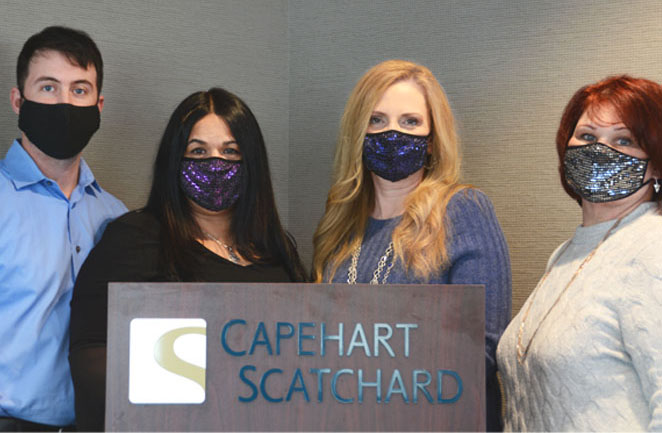
L to R: Andrew Bradley, paralegal, Yasmeen Khaleel, Esq., Renee Vidal, Esq., Kay Sowa, EA, AEP, CTFA

Where are your original estate planning documents?  In a safe place – right?  That safe place could be a safe deposit box at a bank, a fireproof box or safe in your home. Hopefully, not in a container that could burn or perhaps suffer water damage if there was a fire.  There are certain documents such as a Will that only one copy is signed and therefore, the only original.  If that document were destroyed, what would happen? 

There is the likely possibility that, if there is a photocopy, the photocopy could be processed through the Courts as the original Last Will and Testament.  However, that can be an expensive process. 

You feel comfortable knowing that your Will, life insurance policies, deed and other important papers are in your safe deposit box at a bank.  You have been told that, upon your passing, your executor can enter the box to retrieve the original Will to file the same with the Courts and be appointed as the executor.  However, there are some banking institutions that are not allowing entry to the safe deposit box to retrieve the original Will.  The executor will be told that they need a short certificate – the certificate issued by the Court to evidence the appointment of a representative of the estate, which can only be obtained by presenting the original Will.  That sounds so contradictory.  So, what happens now?

You can be firm with the bank that you should be able to retrieve the Will, but you may be told that you need the short certificate.  You can argue that you can’t get a short certification without the Will.  It can become a vicious circle.  And, unfortunately, a battle you most likely will not win.

We have had the experience that the executor has had to file documentation with the court to get permission to retrieve the Will.  This incurs legal and court costs and takes time.  In the meantime, there may be matters pertaining to the decedent’s estate that need immediate attention by an authorized representative. 

So, where is the best place to keep your original Will?  In the past, we would have said in a safe deposit box, but with some financial institutions restricting access after the death of the owner of the safe deposit box, we now do not necessarily feel that way.  If the owners of the safe deposit box include the name of the executor, there should be no problem.  But, if the executor is only listed on the box as an agent under a power of attorney, that authority dies with the box owner. 

Check with your financial institution as to what their policy is regarding the retrieval of a Will after a box owner’s death.  Maybe you really don’t need a safe deposit box.  Most paper contents can be replaced.  Perhaps your estate planning attorney offers the service to clients to keep the original Will as does Capehart.  Think about it and determine what is best for you.

WOW – who would have ever thought that an electronic Will would become acceptable to probate (file of record with the court as being the decedent’s intentions).  Yes, we do so much electronically, but a Will, which back in the day couldn’t have an erasure on it (and I am talking way back in the day before memory typewriters and in the days of carbon paper – if you even know what that is).  Perhaps I am dating myself, but I typed many a Will only to get to the last line of the paper (and it was legal size paper) to make a typo and have to start that page all over again.  OK, so back to current times. 

The Courts are being faced with validating electronic Wills – most of which don’t contain statutory language.  From what I have read, some of the electronic Wills have been admitted, but others have not.  Here are a few stories I have seen about electronic Wills.

A Will was dictated by the testator to a sibling who typed the same on a tablet device.  The testator signed the Will using a stylus and there were two witnesses who signed.  While the Will was not notarized, it was admitted as it was in writing and signed. 

There was a case in Australia where a testator prior to committing suicide created documents on his phone and labeled one to be a Will.  After consideration, the Court found that the Will was admitted to probate. 

Then there are video Wills.  These have been around longer than tablet devices and mobile phones and have been successful in the Courts admitting them to be valid Wills in certain circumstances.  People unable to sign their names but able to speak their intentions have had successful video Wills probated.  The testators must clearly state that the video is intended to be their Will. However, nowadays getting a video Will probated can be more challenging than an electronically written Will. 

The Uniform Electronic Transactions Act which was approved in 1999 allows for the transaction of business electronically.  Almost all states have adopted the UETA, but there is an exception for Wills and testamentary trusts that requires each state to enact legislation to allow for electronically signed Wills to be admitted.  This has led to the Uniform Electronic Wills Act which was approved in July 2019.  This Act continues the traditional formalities of a Will – a writing, a signature and attestation, with some adaptations.  The primary requirement is that a Will be “a record readable as text at the time of signing”.  Further, the electronic Will must be signed in the physical presence of witnesses (per individual state requirement). 

If an individual executes an electronic Will, but later wishes to revoke the same by a subsequent document, this may present challenges.  Since there is no hard copy of the original, this may lead to court involvement to determine the testator’s intent. 

For many years, Wills have been self-proving – meaning that the signature of the testator (in many states, but not all)  and the witnesses are notarized, which eliminates the need for the witnesses to come forward when the will is probated to “prove” their signatures.  There is currently a division among states as to whether the self-proving affidavit can be signed by the witnesses simultaneously and incorporated into the electronic document.  There is also discussion as to the validity of the electronic Will when the testator is physically located in one state at the time of execution but changes residency, prior to death, to another state.  This definitely conflicts with the expression of Wills set forth on paper and signed in ink that “valid where made, valid everywhere”. 

This is a topic that will likely become more commonly discussed as we journey toward being a “paperless” society. 

During my career of doing estate administration, I found in the earlier years that the beneficiaries were more appreciative of what they received.  The children got along and all was well.  However, our society has changed and now there are many cases ending up in court to settle matters which were not able to be settled amicably.  Family members become estranged from one another sometimes over the most trivial matters. 

So, what can you do to keep peace in your family after you go to that great place in the sky?  Here are some basic suggestions for people of all ages to consider:

Is your estate planning up to date – or do you even have your planning done?  This is a very broad term – estate planning – and covers many areas.  Should you die without having completed your estate plan, certain areas will be decided according to law rather than according to your wishes.  These include, but are not limited to, who will inherit your assets, who will become the representative of your estate to handle the administration, who will become the guardian of minor children.  If you don’t want the law to make these decisions for you, then you need to have estate planning done.  Also, the lack of estate planning tends to leave family members feeling like they have a mess to deal with.  Financial records could be incomplete or in today’s world be kept only online and not be evident.  This leaves a mystery of what assets there are and the value.  End of life and postmortem wishes are not known.  Just to name a few.

Estate planning includes addressing the issues stated above, but there is more to it.  A prior blog discussed having the talk with children to let them know what your wishes are, where to locate documents and information when needed, etc.  Keeping too many secrets from your children can present problems.  If you have preplanned your funeral and/or purchased a burial plot, even perhaps planned your memorial service, let your children know where to find this information when the time comes.  If they find it a couple of weeks after you pass, it does no good for any one.  Sharing this kind of information is not easy but it is so helpful.

During your lifetime, there may be a need to have someone act on your behalf to pay bills, handle financial matters, etc. if you are unable to do so.  A Durable Power of Attorney is the document which names an agent to act on your behalf if needed.  Without a Durable Power of Attorney, your family could experience the inability to gain access to your bank account.  Would you want this to happen?

In the event you became unable to make your own medical decisions, a Health Care Directive/Living Will is very important.  This will name an agent to make medical decisions on your behalf according to your wishes.  It provides medical personnel with a point person with whom to discuss your care and how to proceed.  I have seen families with several children and the parents do not have a Health Care Directive.  Each of the children can rationalize why they know what mom or dad wanted and should be able to make the decisions.  However, without a document naming an agent, there is no point person.   This leads to much angst with the family as well as the medical professionals. 

You may have indicated to different individuals your wish that a certain asset was to go to them.  However, if you don’t write it down and after your passing more than one person wants to claim a particular asset, what happens? Each of these persons has their side of the story as to receiving the asset and feels entitled to it.  Once again, angst among the kids.  So, what should you do?

A Last Will and Testament will solve the problem if done properly.  A Will states who is to receive your assets and who is to be the executor to wrap up your affairs.   Generally, a Will addresses the distribution of tangible personal property through a memorandum document which you prepare and place with your Will.  However, failure to complete the memorandum is cause for problems.  Sticky notes on the back or bottom of items are not valid indicators of beneficiaries of items. 

Estate planning also includes making certain that beneficiary designations of life insurance and/or retirement accounts are completed properly.  It should never be assumed that if one beneficiary is designated that they will split the asset with other children.  There may be tax consequences incurred by the designated beneficiary and it would not be fair to have them burdened with tax when they had to share the money. 

An out of date Will can pose many problems.  Let’s say that an unmarried aunt/uncle left nephews and nieces a specific dollar amount in cash.  When the aunt/uncle dies, their assets were insufficient to make payment of these bequests, let alone have any residual to distribute to the residuary beneficiary.  If you have specific bequests in your Will and your financial status changes due to increased expenses, updating your Will to better reflect your current status can save much angst. 

Be realistic when thinking about the disposition of your assets.  If you have a family member with special needs, consider whether an outright distribution from your estate would compromise any benefits they may be receiving.  Would you want the spouse of a child to be able to stake a claim in your child’s inheritance from your estate?  Is there a beneficiary that doesn’t handle money very well?  These are all matters which should be brought up with the attorney who is assisting with your estate planning so that steps can be taken to protect your intentions. 

There are programs on television about hoarders.  While you may not be a hoarder, be realistic about what fills your home.  Have you held on to items just because you think you may be able to use them in the future – even though you haven’t used them in the 10 or 20 years since acquiring them?  The thought of going through the contents of your home can be overwhelming but spending 30 or 60 minutes at a time can help you eliminate your excess.  Charities are always happy to receive donations of items that can be reused.  Leaving your accumulation of excess items is a monumental task for your family to go through.  I’ve cleaned out many houses of clients who passed away and I can tell you that it is not a fun job.  I had no emotional ties to the deceased, but when you think of your children going through each and every item, not only is it a time-consuming job, but it is very emotional.

Be proactive.  Make doing your estate planning a priority or if you have your planning done, review it.  Laws change, people change, change is constantly occurring.  Don’t leave things in a state of disarray for your children to put together like a puzzle without having the picture to look at.  Your intentions are for peace and cohesiveness within your family; not estrangement. 

You have spent days, and maybe even weeks, working with your attorney on your Estate Planning. You finally feel that you have addressed all of your concerns and are comfortable with who your belongings are going to after you pass away. Now, you can sit back and relax and never worry about your estate planning again, right? Wrong.

A common misconception among many individuals is that, once the Will has been signed, then there will be no need to return to it until someone dies. The problem with this approach is that life is always full of unexpected occurrences, both good and bad. Revisiting your estate planning before, during, or after each of these major life events is a prudent way to ensure that the Will you signed ten years ago still accurately reflects your current life situation.

For example, many of us will create Estate Planning documents when we marry in a “Sweetheart” Will format. This means that both spouse’s Wills are identical, with the only difference being the names of the spouses being switched throughout the Will. This can work great for both spouses, especially in the early years of marriage. But what happens if the spouses get divorced later on? Even more, what about if you have children who you don’t really speak to anymore, for one reason or another. If you haven’t updated your Estate Planning since you married, then it is time to review your Will and other documents to make sure your assets are going to be distributed to the proper people.

Revisiting your Estate Planning doesn’t just need to happen when unfortunate events occur in your life. Having a child, going on vacation, or receiving a large sum of money are also times when you should consider updating your estate plan. You might want to consider including a guardian for your child should you and your spouse both pass away at the same time. Or maybe, now that you have more assets, you want to rethink how much you leave to certain individuals or to whom you would like to leave your property.

Life is full of unexpected events. Some good, others not so much. Either way, when these events occur, reviewing your Estate Planning should always be a consideration at the top of your list. Doing so will ensure that you are prepared to expect the unexpected and have contingency plans for when they do occur. Your family and loved ones will be in a better place because of it.

You have now prepared your Last Will and Testament and have named your Attorney-In-Fact in your Power of Attorney, but what about your health? Who will take care of you and your medical needs if you become incapacitated? That is precisely what a Living Will and Advance Directive will provide.

A Living Will and Advance Directive is a document that provides instructions regarding your care during the latter stages of your life. Similar to a Power of Attorney, you will select an individual to serve as your Attorney-In-Fact in this regard. There is also an important decision you must make within the document, and that is the decision regarding whether you would like to continue life sustaining treatment (life support) should the moment arise when doctors have determined there is no more hope for recovery. If that moment should arise, you will not be able to communicate with doctors what you would like done with regard to life support. However, if you have a Living Will and Advance Directive, doctors will be able to clearly see your decision that was made when you were mentally competent and abide by your choice.

A Living Will and Advance Directive also has other benefits. In addition to allowing you to make your own decisions regarding life support, it also will clearly show your intentions and prevent any arguing or disagreements about what you would want should that moment arise. This takes the difficult decision of cutting life support out of the hands of loved ones who may not be in the best mental or emotional state to make that decision. Further, loved ones may disagree and what they believe should happen, potentially leading to arguments and hurting family relations.

Finally, a Living Will and Advance Directive can also include a Healthcare Power of Attorney, which, as mentioned, will give your Attorney-In-Fact authority to make medical decisions for you should you be unable to make your own medical decisions. It also allows your Attorney-In-Fact to speak for you in regards to health care matters. It goes without saying that your Attorney-In-Fact should be someone who you not only trust with your healthcare needs, but also someone who has the emotional and mental ability to make potentially difficult decisions that are ultimately in your best interest. For that reason, it may be appropriate to appoint a trusted person outside of your family to be your Attorney-In-Fact.

The Last Will and Testament, Power of Attorney, and Living Will and Advance Directive are three vital documents that should be a part of everyone’s estate plan. If you do not have either or any of these documents, it is prudent to consider having them created. Being proactive now when it comes to not only your future, but also your loved ones future can help prevent many headaches down the road.

Now that you have considered all of the various possibilities that you may amass a sizeable estate when you pass away, you then must consider to whom you would like the assets to pass to and, just as important, who will administer your estate.

First, the decision of who will inherit from your estate. A Last Will and Testament will dictate to whom your assets will pass to after your death. This provides you with all of the power to tell your loved ones after your death “who gets what” or “who does not get what”. This saves time and money after your death and saves loved ones from potentially fighting over your most prized possessions.

If you have children, you may consider where each child is in life or where you anticipate them to be at the time of your passing. Is one child better off than the other? Does one child need more support due to an incapacity issue? Or do you simply not have a relationship with one child and would not like that child to inherit from your estate? These are all important questions to ask yourself when considering estate planning documents, and each of them can be addressed in your Last Will and Testament. Do not leave it to the State to distribute your assets when you have the ability to control that yourself.

The Last Will and Testament governs the distribution of probate assets as opposed to non-probate assets. What is the difference? Non-probate assets are assets that already have a listed beneficiary on it for the assets to be distributed to upon your death. For example, life insurance, IRAs, joint bank accounts with rights of survivorship, payable on death accounts, are all types of non-probate assets. Each of these accounts will generally have an individual (beneficiary) already listed who will receive the assets of that account upon your death. However, if no beneficiary is listed, then the estate is the presumed beneficiary of the asset and it will then become a probate asset and will be distributed according to your Last Will and Testament.

In addition to cash assets, you may also consider your home if you own one. Who would you like to inherit your property? Do you even want anyone to inherit your home? Or would you like it to be sold first and distribute the proceeds? Again, these all can be addressed in your Last Will and Testament. This will take away any uncertainty with what will happen to your property after you pass away. You can rest assured that your assets will be distributed to the right people in the manner in which you desire when you pass.

When you have finished choosing who to leave your specific property to, what happens to the rest of the assets in your estate? The remaining assets, such as bank accounts, in your estate that do not have a listed beneficiary will pour into what is called the “residue” of your estate. You have the ability to direct how your residuary estate is distributed and to whom it will be distributed.

After considering what you have and to whom the assets will be distributed to, the crucial decision needs to be made as to who will be responsible for administering your estate. This should be person that you trust to be able to gather your assets and contact all of the beneficiaries of your estate in a timely manner to administer those assets from your estate. This person is called the “Executor” of your Estate. The Executor will also be responsible for the payment of any death taxes your Estate may owe as a result of your death and will be responsible for filing income taxes for your Estate as well. You may also list successor executors as well. These individuals will step in for your initially listed Executor should he or she choose not to serve as your Executor or becomes incapacitated and is no longer able to serve as Executor.

A will gives you great power and discretion to see that the proper people receive the assets of your estate. If you have life milestone moments coming up or do not have one, consider seeing an attorney to have your Last Will and Testament drafted.

One of the most important legal documents an individual can ever execute is his or her Will. Until recent years, it was a formal writing prepared by a lawyer to insure that one’s assets were passed to his or her heirs. Yet over the past few decades, alternative planning methods have arisen. Moreover, New Jersey law has begun to allow for the admission of forms that do not comply with statutory law as Wills. Thus, the purpose of this article is to review what constitutes a Will and how imperfect documents might nevertheless be admitted to probate.

At the outset, it should be stressed that individuals should have their Wills prepared by competent counsel. Those who use unqualified lawyers, computer programs and trust mills for their estate planning often trigger disaster for a variety of reasons. These include inadvertently disinheriting loved ones, allocating one’s estate among the wrong beneficiaries and failing to recognize the interrelationship of Wills with non-probate assets. Some of these deficiencies can be corrected though.

Historically, the procedural requirements to execute a Will have been very strict. N.J.S.A. 3B:3-2 states for a Will to be valid it must be in writing and executed by the testator in the presence of two witnesses. Wills that did not meet these requirements simply were not admitted to probate except for holographic Wills (those entirely in a decedent’s handwriting) which, though, required an order of the probate court.

In 2005, New Jersey statutory law was modified to allow for the possibility of documents to be accepted into probate that do not conform with the traditional will statute as valid testamentary writings. Specifically, in relevant part, N.J.S.A. 3B:3-3, entitled Noncompliant execution; Clear and convincing evidence of intent, states, “Although a document or writing added upon a document was not executed in compliance with N.J.S.A. 3B:3-2, the document of writing is treated as if it had been executed in accordance with N.J.S.A. 3B:3-2 if the proponent of the document of writing establishes clear and convincing evidence that the decedent intended the document or writing to constitute: (1) the decedent’s will…” This represented a substantial change in the State of New Jersey’s probate laws.

This legislation created what is commonly known as the “doctrine of substantial compliance”. Since then, a number of cases have been decided to define this concept. The initial case in this area was In the Matter of the Probate of the Alleged Will and Codicil of Macool, Deceased, 416 N.J. Super. 298 (App. Div. 2010). In that case, Louise Macool sought to change her Will after her husband died to expand the residuary beneficiaries from her seven stepchildren to two nieces as well. She spoke with her attorney and he dictated same in her presence. However, she died one hour after leaving the attorney’s office. The court found that clear and convincing evidence existed to demonstrate that Louise Macool wanted to change her testamentary plan and include her two nieces. However, the draft will was not admitted to probate. Specifically, the Court held that her untimely death prevented her from: (1) reading the draft will prepared by her attorney; and (2) conferring with her counsel after reviewing the draft document to clear up any ambiguities, modify any provision or express her final assent to the rough draft. Yet, in clarifying N.J.S.A. 3B:3, the Appellate Division held that an unexecuted or defective writing may be admitted to probate as a Will if there is clear and convincing evidence that: (1) the decedent actually reviewed the document in question, and (2) thereafter gave his or her final assent to it.

Based on the terms of the Macool case as well as the change in statute, case law was set forth legitimizing the doctrine of substantial compliance in In re Ehrlich, 427 N.J. Super. 64 (App. Div. 2012). In that case, it was held that an unexecuted copy of a lost will was to be admitted to probate based on the Court’s finding that same had been executed at the time it was prepared. Based on these two cases and their progeny, there may be opportunities in Court to have a defective or unexecuted Will admitted to probate despite being denied admission by the County Surrogate.
.

Capehart Blogs

Subscribe to Blog Updates

Categories