Full Service Law Firm in Mt. Laurel Township, NJ | Capehart Scatchard

Alternative Energy

On July 20 2022, President Joe Biden called climate change an “existential threat” and unveiled new policies to fight its effects in response to Senator Joe Manchin’s objection to the Biden Administration’s proposed Federal wind legislation, which would create thousands of union jobs and offer more than $12 billion in annual capital incentives for wind projects located on both coastlines of the United States.

Senator Manchin represents West Virginia, which is a state dependent on the coal and natural gas industries. The Senator has personally made his wealth from the coal industry.  Senator Manchin has stated his objection to Biden’s proposed federal legislation is based on a deep concern about recent U.S. inflation. Manchin has suggested he might be open to considering a legislation package that includes climate and tax measures in September 2022, after further reports on U.S. Inflation.

“Climate change is an existential threat,” Biden said at a former coal-fired power plant in Massachusetts that’s being re-purposed to support wind power generation. “Since Congress is not acting as it should — and these guys here are but we’re not getting many Republican votes — this is an emergency, an emergency, and I will look at it that way,” the President said. However, President Biden held back on declaring a formal climate emergency.

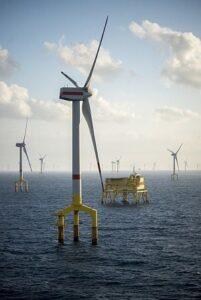
Biden’s climate change policies encourage offshore wind development in new areas along the US Coast and in the Gulf of Mexico. Biden is directing federal regulators to propose the first wind energy areas for development in the Gulf — a step toward auctioning leases to build the renewable projects.  Bloomberg Law reports, “Although Biden is directing Interior Secretary Deb Haaland to advance wind energy development in the southern Atlantic and along Florida’s Gulf Coast, he held off on reversing an order by former President Donald Trump that ruled out new offshore energy leases in those waters”, which could trigger unwelcomed opposition by Congress.

The Biden Administration climate change policy goals includes developing 30 gigawatts of offshore wind power by 2030, with auctions of territory near California expected later in 2022, and, ultimately, lease sales on almost every US coast.

The Bureau of Ocean Energy Management (BOEM) is moving forward with new offshore lease sales and plans to expedite review for operation plans. New ports and factories will need to be developed and constructed closer to the coast lines to service the wind industry.

For more information about New Jersey’s offshore wind programs, please contact Alan P. Fox, Esq.

In addition to investments in clean energy, the bill called the Inflation Reduction Act of 2022 (H.R. 5376) includes tax and health care provisions designed to reduce the federal budget deficit and limit inflation. However, much of the media’s attention has been on the climate provisions. The current compromised bill reduces investments from the original $2 billion “Build Back Better” Act proposed by the Biden administration.

The proposed bill is designed to accelerate the buildout of renewable energy and electric vehicles as well as boost the deployment of nuclear energy and increase domestic clean energy related to manufacturing and advanced energy technologies (such as storage, carbon capture, and green hydrogen).

Below is a summary of just a few of the tax incentives in the proposed legislation as currently drafted:

    • The proposed legislation both extends the existing Internal Revenue Code §45 PTC (production tax credit) and existing Internal Revenue Code §48 ITC (investment tax credit) for projects that commence construction by December 31, 2024, then transitions both §45 and §48 into new replacement tax code sections (one to be designated as “The Clean Electricity Production Credit” under new Internal Revenue Code §45Y and the other to be designated as “The Clean Electricity Investment Credit” under new Internal Revenue Code §48D).
    • Tax-exempt payers will have the option to elect direct pay for the clean electricity PTC and ITC as they would under the proposed amendments to §45 and §48.
    • The proposed bill would increase the ITC to 30% for solar, fuel cells, and small wind facilities in service after 2021.
    • The new proposed bill also creates a new “stand-alone” storage ITC for certain biogas, linear generators, thermal storage, microgrid, and dynamic glass technology.
    • Taxpayers electing the § 48D ITC will receive a credit worth up to 30% of the investment in the year the facility is placed in service. The tax credit value is increased by an additional 10% if the facilities also meet domestic-content requirements.
    • The credit value is further increased by 10% for projects in energy communities, including certain brownfield sites under CERCLA ( or example, where a coal mine has closed, or where a coal-fired electric generating unit has been retired.)

On August 11, 2022, with a tiebreaking vote from Vice President Harris, the 50-50 Senate passed the Inflation Reduction Act and sent the bill to the House of Representatives for a vote. The House is expected to approve this bill and send it to the White House for President Biden’s signature later this week. Solar industry advocacy group SEIA has already suggested that the tax credits under this Act could spur upwards of 30 GW of new solar panel manufacturing capacity in the United States and over 500,000 jobs.

For more information about the Inflation Reduction Act, please contact Alan P. Fox, Esq.

In addition to investments in clean energy, the bill called the Inflation Reduction Act of 2022 (H.R. 5376) includes tax and health care provisions designed to reduce the federal budget deficit and limit inflation. However, much of the media’s attention has been on the climate provisions. The current compromised bill reduces investments from the original $2 billion “Build Back Better” Act proposed by the Biden administration.

The proposed bill is designed to accelerate the buildout of renewable energy and electric vehicles as well as boost the deployment of nuclear energy and increase domestic clean energy related to manufacturing and advanced energy technologies (such as storage, carbon capture, and green hydrogen).

Below is a summary of just a few of the tax incentives in the proposed legislation as currently drafted:

    • The proposed legislation both extends the existing Internal Revenue Code §45 PTC (production tax credit) and existing Internal Revenue Code §48 ITC (investment tax credit) for projects that commence construction by December 31, 2024, then transitions both §45 and §48 into new replacement tax code sections (one to be designated as “The Clean Electricity Production Credit” under new Internal Revenue Code §45Y and the other to be designated as “The Clean Electricity Investment Credit” under new Internal Revenue Code §48D).
    • Tax-exempt payers will have the option to elect direct pay for the clean electricity PTC and ITC as they would under the proposed amendments to §45 and §48.
    • The proposed bill would increase the ITC to 30% for solar, fuel cells, and small wind facilities in service after 2021.
    • The new proposed bill also creates a new “stand-alone” storage ITC for certain biogas, linear generators, thermal storage, microgrid, and dynamic glass technology.
    • Taxpayers electing the § 48D ITC will receive a credit worth up to 30% of the investment in the year the facility is placed in service. The tax credit value is increased by an additional 10% if the facilities also meet domestic-content requirements.
    • The credit value is further increased by 10% for projects in energy communities, including certain brownfield sites under CERCLA ( or example, where a coal mine has closed, or where a coal-fired electric generating unit has been retired.)

For more information about the Inflation Reduction Act, please contact Alan P. Fox, Esq.

On June 8, 2022, the New Jersey Board of Public Utilities issued an Order conditionally granting a petition which requested an extension to the project’s solar Transition Incentive (“TI”) Program registration deadline. As part of this Order, the Board has defined a set of criteria to identify similarly situated projects which may be eligible for a comparable extension.

If you have a TI project that is approaching a registration deadline, please contact Alan P. Fox, Esq., Chair of the firm’s Alternative Energy Group, to explore whether your project is eligible for a comparable extension.

On June 6, 2022, the White House released a statement authorizing the use of the Defense Production Act (DPA) to build up domestic production of solar panels, electric transformers, heat pumps, insulation and hydrogen-related equipment.

The U.S. Department of Energy (DOE) could support those sectors through commitments to buy clean energy products from U.S. manufacturers; direct investments in facilities; and aid for clean energy installations in homes, military sites and businesses. Pending legislation (the Energy Security and Independence Act) would provide $100 billion in DPA funding for the clean energy sector.

The White House reports the expansion to domestic solar manufacturing capacity will grow the current capacity of 7.5 gigawatts by an additional 15 gigawatts, enabling 3.3 million homes to switch to clean solar energy. President Biden also urges Congress to pass tax cuts and additional investments that advance U.S. clean energy manufacturing and deployment.

Specifically, the White House is authorizing the DOE to rapidly expand U.S. manufacturing of the following five clean energy technologies:

    1. Solar panel parts including photovoltaic modules and module components;
    2. Building insulation;
    3. Heat pumps;
    4. Equipment for making and using clean energy-generated fuels, including electrolyzers, fuel cells, and related platinum group metals; and
    5. Power grid infrastructures such as transformers.

Capehart Blogs

Subscribe to Blog Updates

Categories